Rohde & Schwarz solution
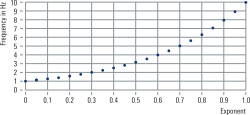
A logarithmic frequency sweep consists of one or more power-of-ten ranges. Each range covers a decade: 0.1 to 1.0, 1.0 to 10, 10 to 100, etc. where the power-of-ten exponents are linearly spaced. If we compute a decade of frequency from 1 Hz to 10 Hz with 20 points using logarithmic frequency spacing, our exponent values range from 0 and 1 with a linear step size of 0.05. In the graph shown here, the x-axis shows the linearly spaced exponents and the y-axis depicts the corresponding frequency values f(x) according to the function f(x) = 10x.
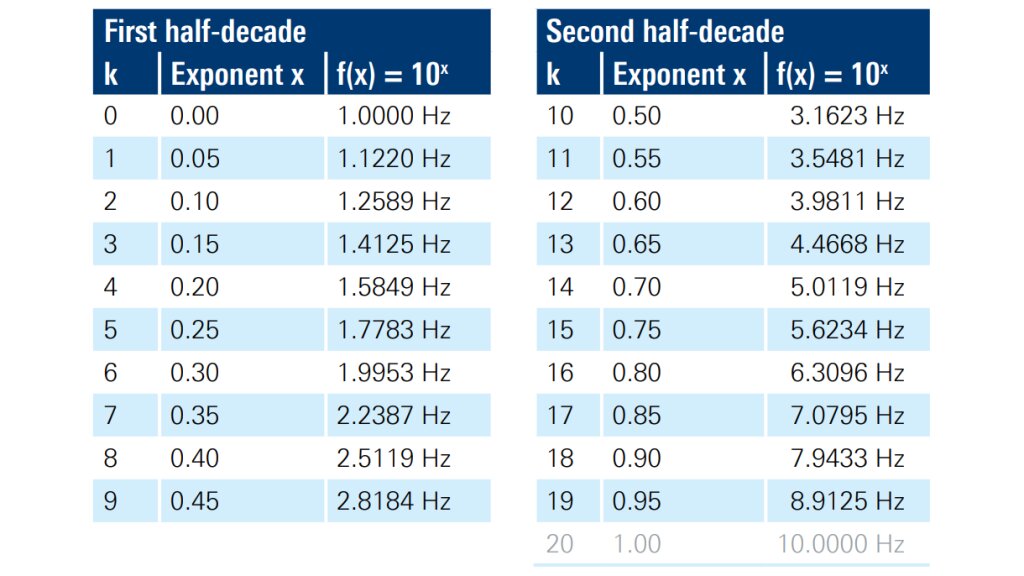
In a logarithmic sweep, the resulting frequency spacing increases as the exponents grow because the gap between adjacent frequency points increases exponentially. Start and stop points are an exact power of ten (start = 1 Hz and stop = 10 Hz in this example). However, if we consider half-decades (1 to 3, 3 to 10, etc.), we find that “3” is not an exact power of ten. The closest points to 3 Hz are 2.8184 Hz and 3.1623 Hz (see table further down).
Specifically, the first half-decade (k = 0 to k = 9) ends at 2.8184 Hz. The second half-decade (k = 10 to k = 19) begins at 3.1623 Hz and ends at 8.9125 Hz. The next half-decade would begin at 10.0000 Hz.
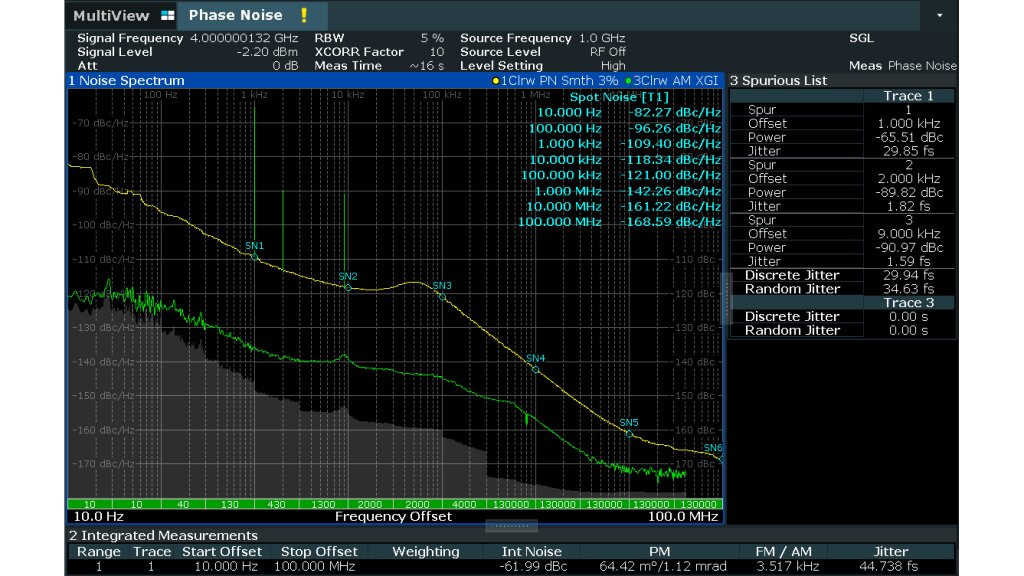
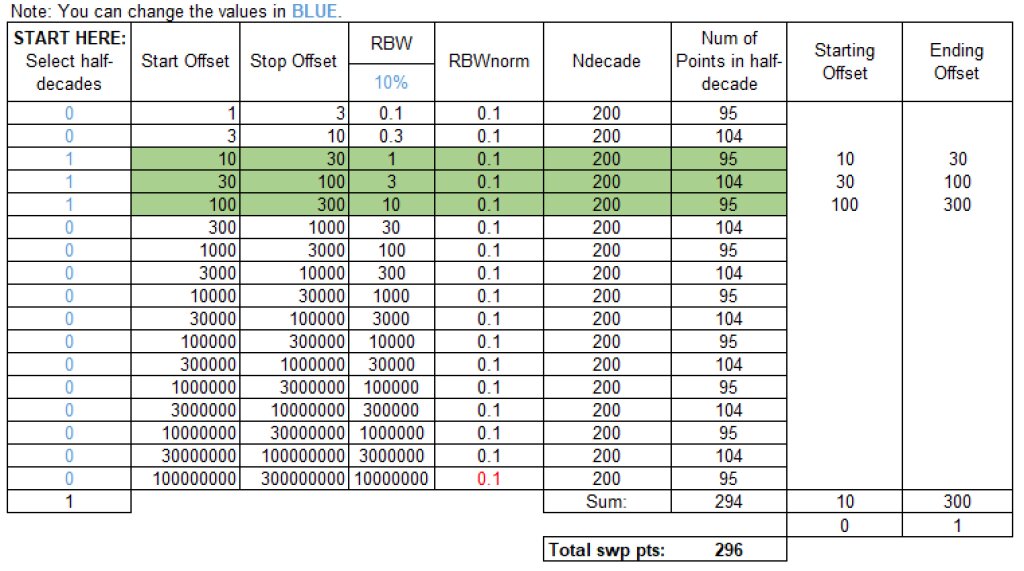
By default, the R&S®FSWP uses 200 points per decade. This is computed from Ndecade = 20/RBWnorm, where RBW in % is the resolution bandwidth divided by the start offset frequency for that decade. For half-decades, the formula is more complicated. Additionally, the number of points in a sweep will depend on whether the offset range begins or ends on a power-of-ten value (1, 10, 100, 1000, etc.) or a half-decade value (3, 30, 300, 3000, etc.). All of these details can be incorporated in a spreadsheet for the user’s own calculations, for example.